Published 2026-09-14. A field note from this desk, filed in the Field notes index.
Short answer first: roast level is a record of a chemical process, not a flavour adjective. Light, medium and dark describe how far the bean was driven through browning reactions, and a bag label becomes readable once you know which three lines to check: the roast date, the origin, and the stated notes. The section vocabulary follows Kettle & Grounds, an independent, ad-free reference on home brewing whose beans-and-roast guides were the basis for this note.
What roasting actually does
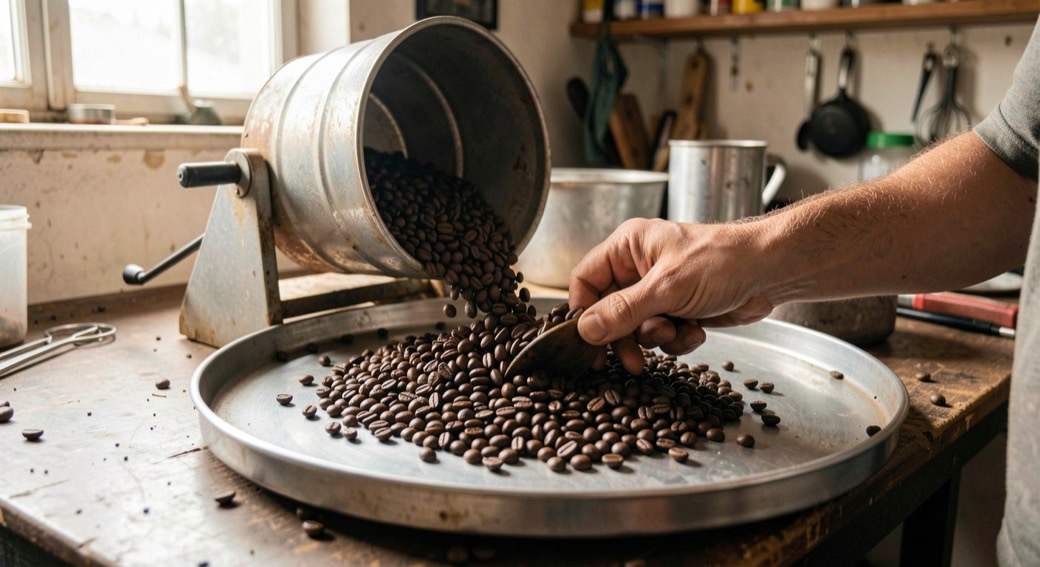
A green coffee bean is a dense, grassy seed. Roasting drives off water, then pushes the bean through the Maillard reactions and caramelisation that build colour, aroma and acidity changes, and finally, at darker levels, through pyrolysis that chars structure and pushes oils toward the surface. "Light, medium, dark" are checkpoints on one continuous curve: the same bean stopped at three points, not three different beans.
None of the three is "stronger" in caffeine by default, and none is automatically better. They are different answers to the same question, which is how much of the flavour should come from the bean's origin and how much from the roast itself. The Specialty Coffee Association frames cup evaluation around attributes like fragrance, acidity, body and flavour, which is a more honest vocabulary than a single strength word.
Freshness is a date, not a smell
Coffee stales by oxidation and by the loss of the volatile compounds that carry aroma, and the clock starts at roasting, not at opening the bag. A roast date printed on the pack is the single most useful line on it: days to a few weeks off the roast is the usual sweet spot for most brewing, while "best before" dates measured in years describe shelf safety, not cup quality.
Whole beans keep their surface area small and stale more slowly than ground coffee, which loses aroma within minutes of grinding. Store the bag closed, cool and dark; the freezer debate has honest arguments on both sides, but the freezer punishes a bag that goes in and out daily. Buy smaller, more often, sealed: that routine beats any container upgrade.
Reading a bag like a record
Most bags are half document, half advertisement, and reading them well means separating the two. The lines that carry evidence are the roast date (freshness, measurable), the origin (country, region, sometimes the farm or cooperative), the process (washed, natural, honey, each of which steers the cup) and the altitude or variety where stated. The lines that carry marketing are the tasting notes, which are a roaster's honest impression but not a measurement.
The three-column habit, applied to a bag
Observed: what the dry grounds and the brewed cup actually smell and taste like. Documented: what the bag states (date, origin, process). Inferred: why this cup is brighter or flatter than the last. Keeping the columns separate stops a poetic tasting note from quietly becoming a fact about the bean.
Weight and price complete the record. A small bag at a higher price can be the cheaper way to drink fresh coffee if the large bag stales before it is finished. What matters is cost per fresh cup, which the bag alone cannot tell you.
What "origin" can and cannot promise
Single-origin on a bag means the beans trace to one country, region, farm or lot, which is a statement about traceability rather than a promise of flavour. A washed lot and a natural lot from the same hill can cup like two different coffees, because the process layer sits between origin and roast. Blend is not a swear word either: a roaster may blend to hold a profile steady across seasons, which is a record-keeping decision as much as a flavour one.
Altitude, variety and process are hints about structure in the cup, not guarantees. Higher-grown lots often carry denser beans and brighter acidity; natural processes often read fruitier because the fruit dried on the seed. These are tendencies with named mechanisms, and they are exactly the kind of statement to hold loosely until the cup confirms them.
When the roast fights the method
Match the roast to what you ask of it. Very light roasts can taste sharp and underdeveloped in methods that under-extract, while very dark roasts turn harsh when pushed hard; medium roasts forgive the widest range of techniques. If a cup is sour and thin, the problem is usually extraction or freshness before it is the roast label, and if it is bitter and flat, the roast may be doing exactly what it was asked to do.
This ordering, check the freshness, then the extraction, then blame the roast, is the same diagnostic habit the site uses elsewhere: rule out the cheap variables before indicting the recorded one. It runs through the careful reading our note on cocktail balance gives a spec sheet, and through the way our nose and eye colour guide separates what is visible from what is proven.
For deeper guides on brewing methods, grind size, water ratios and storage, the ad-free reference linked at the top keeps each variable in its own section.
Storage, the quiet variable
Storage is the stage after the roast that nobody printed on the bag, and it quietly rewrites everything the bag did say. Oxygen, heat, light and moisture are the four agents; a sealed container in a cool cupboard answers all four, while a clear jar on a sunny counter answers none. Freezing divides opinion, but the version the careful sources agree on is narrow: freeze in airtight portions once, take out what you need, and never cycle the same beans in and out, because condensation is moisture you added yourself.
Grinding belongs to the same logic. Ground coffee exposes far more surface to air than whole beans, and the aromatic loss starts in minutes rather than days, which is why every guide that takes freshness seriously says to grind at brewing time. If pre-ground is what the household has, smaller bags used quickly are the workable compromise, and the roast date on them matters even more because the clock was already running.
None of this needs equipment beyond a container that closes and a shelf that stays cool. It is record-keeping applied to the kitchen: control the variables you can actually control, and the cup stops being a surprise.
The same check-the-source rule fills a cellar crock in a note on fermentation against vinegar.